Tuesday, October 22, 2013

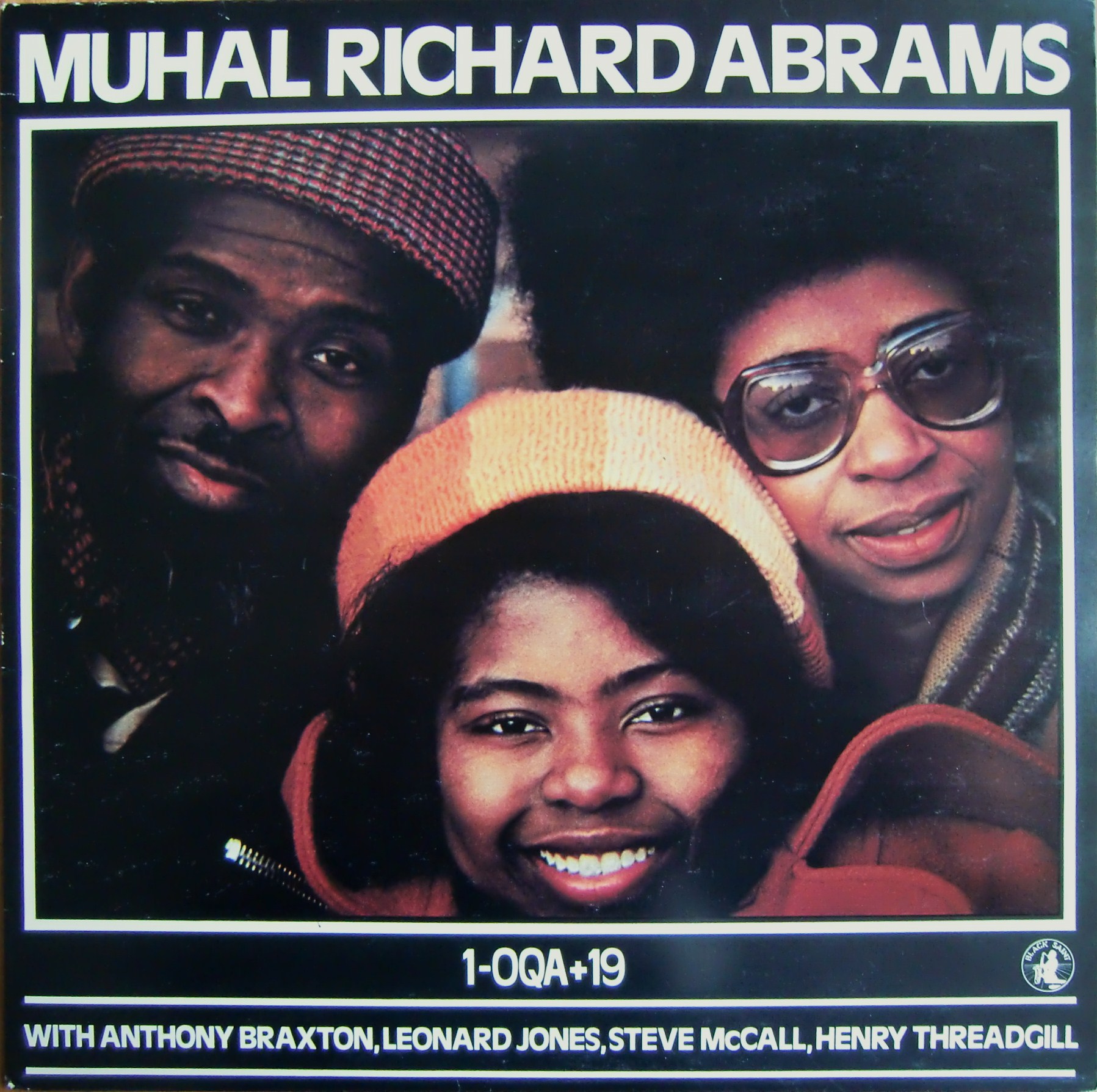
Muhal Richard Abrams - 1-OQA + 19

Now this album has some mystery and intrigue. I wish I understood the meaning of the title/ poem 1-OQA + 19. Maybe some things are best left vague? The composition "OQA" features Henry Threadgill and Anthony Braxton reading Abram's poem. The best term I can think of for it is Cageian, although maybe Abramsian is more proper.

I like this album for it's even balance of complex, modern compositions which involve very orchestrated parts, and it's moments of pure group free improvisation. It never sounds like hell breaking loose... there is always a gameplan that is evident if not obvious.

This is my first foray into Muhal Richard Abrams. It is also one of my first forays into the Black Saint/Soul Note catalog (Great 70's and 80's Avant Garde jazz label from Italy)

I like hearing Henry Threadgill teamed up with Anthony Braxton. Abrams on synthesizer is always a treat. Steve McCall. I love Steve McCall. I always draw a blank when people ask me for great jazz drummers (so many to choose from). I have to remember next time to answer with "Steve McCall." I'm sure we'll hear more about him in my next post, which will be about the group Air.

I adore the picture of Muhal on the back of the record:


Monday, October 21, 2013

On to the next one: Muhal Richard Abrams - Young at Heart and Wise in Time


I have two Muhal Richard Abram records, and this is the newer one to my collection. I also have the CD box set of the Muhal Richard Abram Black Saint/Soul Note large group recordings. One of the most interesting books I've read is George E. Lewis' A Power Stronger than Itself. The book is a comprehensive overview of the history of the AACM. Muhal Richard Abrams is one of the founders of the group, and he includes other key members from the AACM on the second side of this album: Henry Threadgill, Leo Smith, Lester Lashley and Thurman Barker. The ensemble piece "Young at Heart," Is very experimental, but eventually a groove establishes half way through. This isn't my favorite avant-garde recording, but I like hearing early examples of Henry Threadgill and company collaborating with Mr. Abrams. The other side is a piano solo by Muhal. I enjoy it, but I don't feel that it lives up to Amus Mor's liner notes, which states, "the piano plays in blues, marchtime, stride, bop, freedom, and at last stretches on out there."

Next record - John Abercrombie - Gateway


I keep this record filed under John Abercrombie, although I believe the trio of John Abercrombie, Dave Holland and Jack DeJohnette worked as a collective named Gateway, which is the title of this record. This record was a great find: $1 at Family Sharing. I remember going to Family Sharing to pick up some stuff as I prepared to move out into my own place, so there is a little bit of nostalgia associated with this record for me.

The album cover deserves to be on Crap Jazz Covers, as it is a terrible album cover.

Although I really want to like the whole album, the only song I really enjoy is the first track, "Back Woods Song." The title suggests that they are jamming away in some cabin in the country. The picture of Dave Holland's epic winter beard adds to the effect:
That's Dave Holland on the right.

I have a lot of jazz records which I'm excited to listen to, but I also am excited to relisten to some weird stuff that I have that I don't take out too much anymore. (Star Wars narration, Pras - Ghetto Superstar, Styx, etc.)

Friday, October 18, 2013

My Records - John Abercrombie Timeless

I have decided that I am going to listen to all of my records, and I am going to listen to them in alphabetical order. While listening to them, I'm going to blog about each one.
John Abercrombie - Timeless.
John Abercrombie: guitar; Jan Hammer: Piano, Synthesizer, Organ; Jack Dejohnette: drums

This is a classic ECM record, and it may be one of John Abercrombie's most memorable records. It's fusion and jazz, but not in such a macho, Mahavishnu Orchestra style (even though Jan Hammer played keys with the M.O.). This record has the crystalline, ECM sound (Reverb). My favorite tracks are "Ralph's Piano Waltz" (with Hammer playing organ) and "Timeless."
I remember finding this record at a record convention in Marquette, MI back in my college days. I was made aware of Abercrombie's Timeless by watching this Black Milk production of Slum Village's Reunion. I was excited that I was able to find it in Marquette MI, which didn't have a lot of places to find rare gems. I think my folks were up visiting me, and I think may have spotted me the $4 cost of this record. Thanks Mom and Dad!

Three excellent musicians playing great pieces. When I listen to the title track, I always get excited when I hear the part in Jan Hammer's solo that is sampled in "Reunion."

Monday, July 4, 2011

David Murray Octet - Murray's Steps

David Murray Octet - Murray's Steps

David Murray - Tenor Sax, Bass Clarinet
Henry Threadgill - Alto Sax, Flute
Bobby Bradford - Trumpet
Lawrence "Butch" Morris - Cornet
Craig Harris - Trombone
Curtis Clark - Piano
Wilber Morris - Bass
Steve McCall - Percussion

1. Murray's Steps
2. Sweet Lovely
3. Sing Song
4. Flowers for Albert


I believe I first heard David Murray on Jack Dejohnette's album Special Edition. I was impressed by how similar his bass clarinet playing was to that of Eric Dolphy. I somehow never checked out David Murray's history until recently. Murray was discussed often in Gary Giddins' book Rythm-a-Ning. The book focussed on Jazz's traditions and innovations in the early 1980's. David Murray was a key figure in 1980's jazz, which, as a jazz "niche," is something I've become interested in (anyone looking for places to read about 1980's jazz should read Ethan Iverson's blog post as well as this article from allmusic.com).

Murray's Steps is a document of David Murray's octet. The album was released in 1983 on the Black Saint label. I have listened to an interview with David Murray which I found somewhere on the internet. In it, he said he focusses his energy on making sure the music he writes fits the ensemble he has. I'm sure he spent a lot of time rearranging his compositions for his octet on this album. The octet is a large band; yet, it is not a big band. By this I mean that Murray did not have a trumpet section, a saxophone section, a trombone section, per se. He did have trumpet and cornet as well as tenor and alto saxophone for his arranging discretion. While listening through this album, it is refreshing to hear how all eight musicians have a clear role in the musical program.

One of the pieces that Murray is well known for is the last song on this album, "Flowers for Albert." This song is generally considered a tribute to Albert Ayler, but I just came across this blog devoted to David Murray that gives a lot of information about the piece as well as about David Murray's career that says otherwise. I enjoy the song for a few reasons. The form is easy enough to follow, the bass part and the harmonies have almost a caribbean feel, and the melody is very smooth. I like how the song starts out with the Craig Harris blowing the bass pattern on his trombone.

If you want to hear a sample of the tune, you can watch David perform the song in 2009 on youtube (with his Black Saint quartet, so the tune has a different feel arranged for the smaller group.)

If anyone ever told you that jazz died anytime before 1983, you must do yourself a favor and seek out The David Murray Octet's Murray's Steps. David Murray has formed many different groups in his career, and I think all of them are high quality, energetic, passionate, and feel good. So if you find yourself in a music store with a David Murray album in your hand, and you wonder if you should purchase it, more than likely, the answer is yes.

p.s. Shout-out to Bullseye records for hooking me up with this record.

Thursday, November 18, 2010

John Coltrane - My Favorite Things: Coltrane in Newport


John Coltrane Newport '63 and '65

John Coltrane - Tenor and Soprano Sax
McCoy Tyner - Piano
Jimmy Garrison - Bass
Roy Haynes - Drums ('63)
Elvin Jones - Drums ('65)

1. I Want to Talk About You
2. My Favorite Things
3. Impressions
4. Introduction of group
5. One Down, One Up
6. My Favorite Things

1-3 recorded from 1963 Newport Jazz Festival, 4-6 recorded at 1965 Newport Jazz Festival.

I was excited to see this c.d. for sale at Barnes and Noble. I have heard Coltrane's performance at the '63 Newport festival, and I have always thought it was a great recording of his sound at the time. I also found the recording interesting because Roy Haynes was subbing for Elvin Jones on the drums... I'm starting to digress. The c.d. that I found at B&N contains the 1963 performance (with a longer version of "Impressions" than previously released), as well as two songs from the band's 1965 Newport performance (with Elvin Jones back behind the kit). This multi-performance c.d. was on sale for $7.99! The advantage of becoming an avid jazz c.d. collector in the age of digital downloads is that bookstores are practically giving away amazing music.

I haven't listened to the disc enough to determine which "My Favorite Things" is superior. I do think that hearing Roy on the drums is a bit refreshing, as some of the others tried to recapture what they played on their recording two years prior. Both Roy and Elvin come up with great, rhythmic 2 against three feels throughout the song. I have always like listening to Coltrane tunes played in 3/4 time; "My Favorite Things" is one of the more popular Coltrane waltzes, but I am always excited when listening to versions of "Afro Blue" and "Greensleeves," which was recorded on the album Africa/Brass.

The first three tracks (from 1963) are great with Roy on the kit. "I Want to Talk About You" begins as a slow ballad, but the tempo surely enough gets divided into a double-time feel. "Favorite Things" is solid. "Impressions" is cooking as well. The old Newport '63 contained a truncated version of "Impressions." This "extended" version is a bit misleading; Jimmy Garrison's bass solo is pretty much completely edited out! The reason for this is because of a live technical difficulty during the concert. Jimmy's bass was so distorted, that the recording engineers felt they could not modify it to sound reasonable for the recording. Therefore, Jimmy plays about two measures of what probably was a five minute long bass solo and then starts walking in d minor to cue the head of "Impressions."

The last two songs are also top notch. I wanted to hear a recording of Coltrane playing "One Down, One Up," because I had just heard a Milwaukee guitarist (Steve Peplin) perform the tune with his sextet. The Newport '65 recording did not dissapoint me. There was great playing by all the musicians. The '65 performance ends with the crowd screaming for more, but the m.c. informs the audience that the band can not perform past the area's curfew.

This is a really great deal. If you don't have many Coltrane recordings, this would be a great purchase. You pretty much get two records for less than the price of one.

p.s. Roy Haynes is still playing in his 80's. Check him out.
Monday, September 20, 2010

Smalls


I am breaking my trend of posting descriptive reviews of my jazz library (I have added a few titles to my collection that I should write about in the future...) in order to bring Smalls live webcast to the attention of masses.

Smalls is a jazz club in Greenwich Village. They bring in New York jazz artists on a nightly basis. One of the unique things the club does is a webcast of live performances. Check it out sometime!